
Global Investing · June 11, 2026
Lifestyle Stacking: The New Way Smart Families Are Building Global Real Estate Portfolios
There was a time when the “dream” real estate portfolio was fairly simple.
A primary home. Maybe a beach house. Maybe one family property everyone fought over during holidays.
That was the model.
Today, I am watching something very different happen.
Families are no longer just buying second homes. They are building lifestyle portfolios. They are choosing homes across climates, countries, seasons, and family needs with real intention.
I call this lifestyle stacking.
And when it is done well, it is one of the most interesting shifts happening in global real estate right now.
Not because it is flashy. Not because it looks good in a brochure. And certainly not because everyone needs five homes in five countries.
That is not the point.
The point is that real estate is becoming less about collecting properties and more about designing optionality.
Where do you want to spend winter? Where do your children feel most connected? Where can you work without compromising your quality of life? Where can your family gather for the next twenty years? Where does your health, wealth, and lifestyle actually improve?
Those are much better questions than, “Where should I buy a vacation home?”
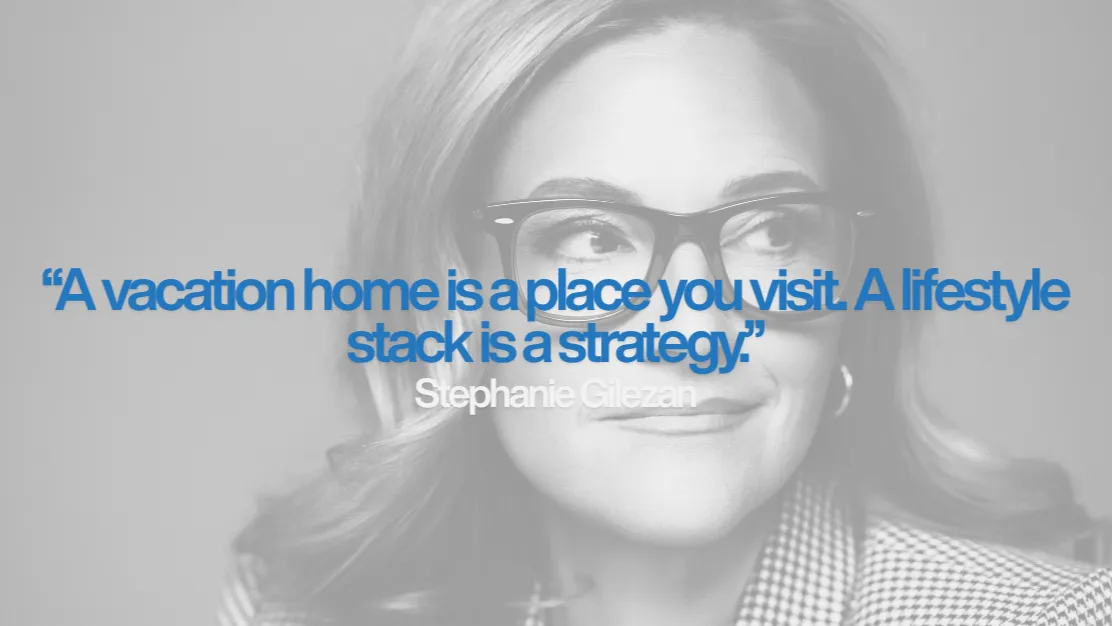
A vacation home is a place you visit.
A lifestyle stack is a strategy.
And that distinction matters.
What Lifestyle Stacking Really Means
Lifestyle stacking is the deliberate assembly of a portfolio of homes where each property has a specific role.
Not random homes. Not emotional purchases. Not a collection of pretty places that seemed like a good idea after three glasses of wine on vacation.
Each home has a job.
One may be the sun home. A warm-weather base for the winter months where the family can slow down, reset, and escape the cold.
One may be the mountain home. A ski base or nature retreat that supports winter sports, wellness, and family tradition.
One may be the city home. A place for work, culture, business access, education, or shorter strategic stays.
One may be the heritage home. The long-hold property where family history is built. The farmhouse in Tuscany. The estate in Provence. The coastal compound. The place where the next generation learns that family is not just a group chat.
Not every property has to do every job.
That is where many people get it wrong.
They try to make one home serve every purpose. Investment. Lifestyle. Retirement. Family gathering. Rental income. Tax planning. Legacy. Easy access. Personal joy.
That is a lot to ask from one property.
The smartest buyers understand that different homes can serve different functions. The strategy is not to buy more. The strategy is to buy more intentionally.
This Is Not Just for Billionaires Anymore
Years ago, this kind of portfolio was mostly reserved for the ultra-high-net-worth buyer.
That has changed.
Remote work changed it. Better travel access changed it. Global rental demand changed it. Improved property management changed it. Currency opportunities changed it. Technology changed it.
A family today can buy in markets they may not have considered twenty years ago, use the property for weeks or months at a time, and rent it when they are not there.
That rental income does not magically make every deal smart. Let’s be clear about that.
A spreadsheet can lie beautifully when the assumptions are lazy.
But in the right market, with the right property, the right management, and the right usage plan, income can help support the ownership cost. That opens the door for more buyers to think globally, not just locally.
This is not about pretending everyone needs a villa in every time zone.
It is about recognizing that global real estate is becoming more accessible to people who are strategic, disciplined, and thoughtful about how they buy.
Not reckless. Not impulsive. Strategic.
There is a difference.
The Four Corners of a Lifestyle Stack
When I look at a lifestyle portfolio, I like to think in terms of four corners.
The first is the sun home.
This is the warm-weather property. It may be Costa Rica, Cabo, the Caribbean, Greece, or another climate-friendly destination where the family wants to spend meaningful time during colder months.
The second is the mountain or nature home.
This could be Aspen, Park City, Switzerland, Sweden, Patagonia, or an emerging alpine destination. It is not always about skiing. Sometimes it is about air, space, privacy, and a completely different pace of living.
The third is the city home.
This is the work and culture anchor. New York. London. Milan. Lisbon. Madrid. Mexico City. A place that keeps the family connected to business, education, healthcare, arts, and opportunity.
The fourth is the heritage home.
This is the emotional anchor. The long-hold property. The place where family memories compound. It may not produce the highest yield on paper, but it may produce the highest return on life.
That phrase matters.
Return on life.
Because not every return is measured in quarterly income.
Some returns are measured in summers your children remember. In aging parents who can gather comfortably. In a place where your family identity becomes tangible. In having a base somewhere that gives you mobility, perspective, and peace.
That may sound sentimental.
It is also strategic.
The families who understand this are not choosing between lifestyle and investment. They are learning how to make the two work together.
Where People Get in Trouble
Now, let’s be honest.
Buying the homes is the easy part.
Living in them well is the hard part.
This is where the fantasy can fall apart very quickly.
If you buy a property intending to spend eight weeks there and you only use it for six days, that is not a lifestyle strategy. That is an expensive postcard.
If every property has a different manager, different maintenance system, different rental process, different tax advisor, and different calendar, congratulations. You have not built a portfolio. You have built yourself a second job.
A very glamorous second job, perhaps.
But still a job.
Lifestyle stacking only works when the homes are managed as one portfolio, not five separate hobbies.
That means usage needs to be intentional.
Day counts matter. Tax residency matters. Rental readiness matters. Maintenance matters. Insurance matters. Local rules matter. Access matters.
A beautiful villa that is impossible to maintain is not a dream. It is a liability with a view.
This is why due diligence cannot stop at the property itself.
Buyers need to understand the full operating reality.
Who opens the home before you arrive? Who handles repairs? Can it legally be rented? Is there reliable local management? How often will you actually go? What happens if the market shifts? Who is the future buyer when you want to exit?
These are not boring questions.
These are the questions that protect the dream.
Geography Is Strategy
One of the most overlooked parts of lifestyle stacking is geography.
People love to imagine the most romantic version of a global portfolio. A home in New York. A villa in Australia. A ski chalet in the Alps. A beach home somewhere requiring three flights, one ferry, and a small miracle.
Lovely on paper.
Brutal in real life.
Access matters more than people want to admit.
If a home is hard to reach, you will use it less. If you use it less, it becomes harder to justify. If it becomes harder to justify, it turns into guilt, expense, and eventually resentment.
That is not luxury.
Luxury is ease.
The strongest lifestyle stacks usually have some practical logic behind them. Flight time. Seasonality. School calendars. Work demands. Family roots. Medical access. Rental demand. Currency exposure. Tax exposure.
This is where the planning gets serious.
An East Coast family may build an Atlantic stack: primary home in New York or Boston, winter base in Costa Rica, summer home in Italy, perhaps a city or heritage property in Europe.
A West Coast family may build a Pacific stack: California primary, mountain base in Park City, sun home in Cabo, and a cultural anchor in Mexico City or Asia.
A European family may build around London, Lisbon, Tuscany, Greece, Sweden, or the Alps.
There is no one correct stack.
There is only the right stack for the family, their rhythm, their capital, and their long-term goals.
That is why copying someone else’s portfolio is lazy strategy.
What works beautifully for one family may be completely wrong for another.
The Real Shift
The bigger trend here is not that people want more homes.
People have always wanted beautiful homes.
The real shift is that buyers want their real estate to create mobility, lifestyle, resilience, and optionality.
They want places where they can work. Places where they can rest. Places where their children can grow. Places where the family can gather. Places that may also produce income when not in use.
They are not just asking, “What can I afford?”
They are asking, “What kind of life are we building?”
That is a much more powerful question.
And frankly, it is the question more buyers should be asking before they purchase anything abroad.
Because excitement is not a strategy.
A pretty website proves nothing.
A gorgeous view does not solve poor access, weak management, bad rental rules, unclear title, or a property that does not fit the way your family actually lives.
The right property should not just photograph well.
It should function.
My Point of View
Lifestyle stacking is not about excess.
At its best, it is about alignment.
It is about building a real estate portfolio around the actual seasons of your life, not just the markets everyone is talking about.
It requires taste, yes. But taste alone is not enough.
It requires discipline.
You need to know what each home is supposed to do. You need to understand how it will be managed. You need to be honest about how often you will use it. You need to know whether the economics are real or just dressed up nicely in a sales deck.
And you need to resist the temptation to buy emotionally and justify strategically later.
That is where people get in trouble.
The smartest buyers do the reverse.
They define the strategy first. Then they find the property.
That is the difference between owning real estate and designing a life.
And that, to me, is where global property gets very interesting.
Because the future of luxury real estate is not just bigger homes, better amenities, or more impressive addresses.
The future is usefulness.
A home that fits the season. A home that supports the family. A home that earns when appropriate. A home that creates access. A home that gives you choices.
That is real luxury.
Not noise. Not flash. Optionality.
And in a world where families are thinking more globally, working more flexibly, and planning more carefully, optionality may be the most valuable asset of all.
If you are considering building a global property portfolio, do not start with the listing.
Start with the life.
Then build the stack around it.
If you were building a lifestyle stack, what would your first priority be: sun, mountains, city access, or a heritage home?
Originally published on LinkedIn on June 11, 2026.
- Global Real Estate
- Luxury Real Estate
- International Real Estate
- Second Homes
- Wealth Strategy
- Airdomo
- Real Estate Investing
- Lifestyle Investing
- Destination Real Estate
- Property Portfolio