
Global Investing · September 2, 2026
Saint Lucia’s Real Luxury Is Restraint
The island is not trying to outbuild the Caribbean. It is protecting the scarcity that makes people want to own there in the first place.
The most valuable thing Saint Lucia has built may be what it refused to build.
Across the Caribbean, development is usually treated as an uncomplicated good. More resorts. More towers. More subdivisions. More inventory pressed against the same coastline until the view that originally created the demand begins to disappear behind the product built to capture it.
Saint Lucia has taken a different position.
The island has deliberately protected its coast, hillsides, and natural character through planning controls that limit how quickly and aggressively it can be developed. That restraint is sometimes presented as a limitation.
For the right buyer, it is the entire investment thesis.
Scarcity is not simply what makes Saint Lucia beautiful. It is part of what protects the value of owning there. When an island cannot endlessly manufacture more oceanfront land, more hillside views, or more properties beneath the Pitons, the supply story becomes fundamentally different from a destination where every available parcel is waiting for its next tower.
Saint Lucia is not trying to win the Caribbean development race.
It is protecting the reason people entered the race in the first place.
That distinction matters because Saint Lucia rewards a very specific kind of buyer.
This is not the market for someone looking to double their money in eighteen months. It is not built around rapid speculation, aggressive turnover, or the assumption that the next development announcement will immediately reset every comparable sale.
Saint Lucia is built for the buyer who wants three things from the same property: a place to use, an asset that can earn while they are away, and a home they will still be proud to own twenty years from now.
Tourism supports that model. Saint Lucia has an established identity as a honeymoon, boutique-travel, and luxury villa destination. That demand feeds the short-term rental market, particularly for villas and professionally managed resort residences. Many developments offer rental programs that allow an international owner to generate income without personally managing bookings, maintenance, or guest turnover from another country.
The property is not passive because somebody added the word “investment” to a brochure.
It becomes passive because the market, management infrastructure, and guest demand already exist around it.
That is why the first question in Saint Lucia should not be, “What can I buy?”
It should be, “How do I want this property to function in my life?”
The answer usually points you toward one of two very different versions of the island.
The north is built for operating.
Cap Estate and Rodney Bay form the most developed and active part of Saint Lucia. This is where buyers find the marina, golf, restaurants, established resorts, management companies, and the supporting infrastructure that makes a property easier to own from a distance.
For a first-time international buyer, that convenience matters more than most people expect.
Buying a beautiful property is only the beginning. Someone still has to maintain it, market it, welcome guests, handle repairs, and keep the calendar moving when the owner is several countries away. In the north, that ecosystem is already established.
A buyer can purchase a modern condominium near the beach or golf course and enter an existing rental market instead of trying to create one from nothing. Airdomo’s listings in the area range from Gate Park condominiums starting in the low two hundreds of thousands to a marina waterfront investment in Rodney Bay listed at $7.5 million.
Those are radically different properties, but they benefit from the same underlying advantage: activity.
The north gives owners the shortest path between the closing table and a property that is actually functioning.
The south is built for falling in love.
Move toward Soufriere and the entire character of the market changes.
This is the Saint Lucia people recognize before they know the name. The Pitons rising above the coast. Villas positioned into the hillside. Low-density development. Privacy, views, and boutique-resort living taking priority over convenience and commercial activity.
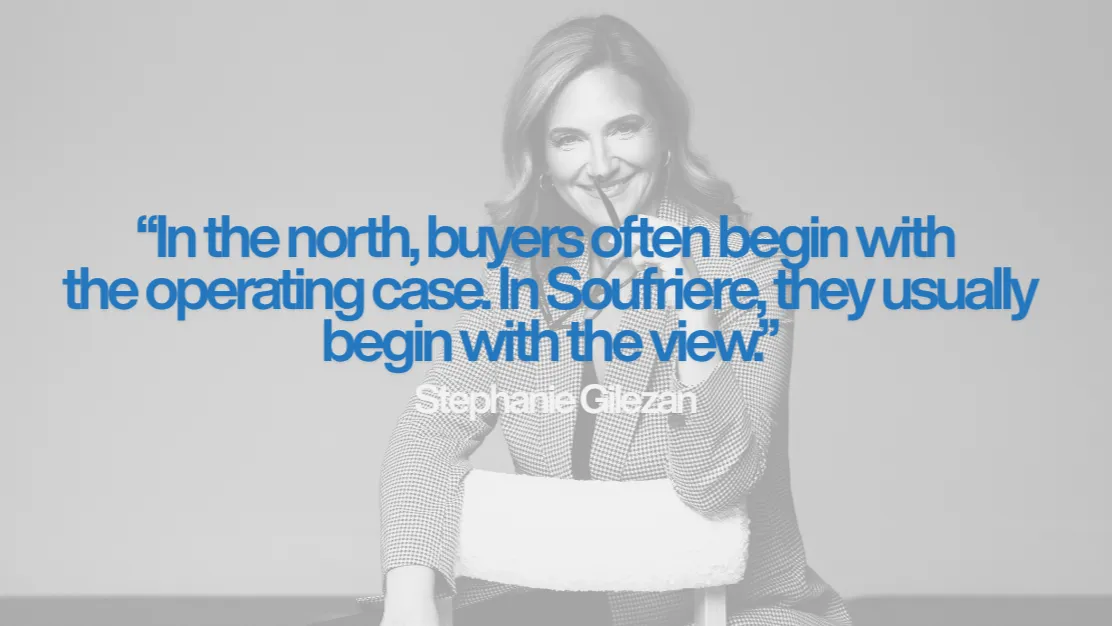
In the north, buyers often begin with the operating case.
In Soufriere, they usually begin with the view.
That does not mean the property cannot earn. The destination has obvious appeal to luxury travelers, honeymooners, and guests seeking an experience that feels removed from the busier parts of the Caribbean. But the purchase decision is generally led by privacy and emotional value, with rental income supporting the ownership rather than defining it.
Hewanorra International Airport is also being expanded at this end of the island, improving access to the south and strengthening the long-term case for properties that historically felt more remote.
Then there is Marigot Bay, halfway up the west coast.
Marigot Bay occupies its own category. It is a natural deep-water harbor with a working marina, waterfront residences, and properties that can combine a private home, a dock, and additional rental accommodations within the same asset.
Airdomo’s waterfront listings there begin around a couple of million dollars and extend into the high single digits.
Marigot Bay is neither the busiest part of the island nor the most isolated. It gives buyers a genuine neighborhood and marina environment while retaining the sense of privacy that draws people toward Saint Lucia’s western coast.
Taken together, Soufriere and Marigot Bay represent the side of Saint Lucia that buyers choose for the experience first.
It is the part of the island people fall in love with and then quietly find a way to justify.
For some buyers, however, the property is only half of the strategy.
Saint Lucia also operates a citizenship-by-investment program, which can turn a real estate purchase into a broader decision about mobility, residency, and international planning.
Foreign buyers can own property outright, with the same underlying ownership rights available to local purchasers. An Alien Landholding License is required, but it is a standard part of the process typically handled by a local attorney. The legal system is based on English common law, and most closings take approximately 60 to 90 days.
Through the citizenship route outlined in the program, an approved real estate purchase begins at $300,000 and must be held for five years. A separate fund contribution option begins at $240,000, although that route does not include ownership of a property.
For the buyer who already wants a home in the Caribbean, the approved real estate route can change the calculation.
The villa and the passport no longer have to be two unrelated decisions. The buyer can place capital into an approved property, satisfy the required holding period, and emerge owning both real estate and a second citizenship.
That does not make Saint Lucia a zero-tax market. Owners should expect annual property tax, transaction expenses, legal costs, and the other realities that come with cross-border ownership.
But the structure is relatively easy to understand: direct property ownership, a familiar legal framework, and a defined citizenship path for buyers who qualify and purchase through an approved project.
The passport should never be treated as a free accessory attached to a villa.
It is a separate strategic benefit that can make the right property considerably more relevant to the right buyer.
This is why Saint Lucia cannot be reduced to one investment story.
For the buyer prioritizing established rental demand, easier remote ownership, and the infrastructure needed to operate a property from abroad, the conversation should begin in Cap Estate and Rodney Bay.
For the buyer prioritizing privacy, dramatic views, low-density living, and the emotional value of owning in one of the Caribbean’s most recognizable landscapes, the conversation moves toward Soufriere and Marigot Bay.
For the buyer thinking beyond property alone, an approved development may allow the home and the citizenship strategy to arrive together.
Different locations. Different purposes. Different ownership experiences.
The common thread is restraint.
Saint Lucia has chosen not to dilute the very qualities that make people want to visit, rent, and own there. Its long-term value proposition is not based on becoming the most developed island in the Caribbean.
It is based on refusing to become interchangeable with one.
In a market where almost every destination promises more, Saint Lucia’s strongest promise may be that it will remain recognizably itself.
That is not a flaw in the market.
That is the feature.
If you are considering a Caribbean property and want to understand which version of Saint Lucia fits your lifestyle, investment goals, and international strategy, explore what we have listed through Airdomo. The right purchase begins with knowing not only where you want to own, but how you want that ownership to work.
When choosing an international property, which matters more to you: established rental infrastructure, privacy and natural beauty, or the possibility of gaining residency or citizenship through the investment?
Originally published on LinkedIn on September 2, 2026.
- Saint Lucia
- Caribbean Real Estate
- International Real Estate
- Luxury Real Estate
- Second Homes
- Property Investment
- Citizenship By Investment
- Global Real Estate
- Airdomo