
Commercial Real Estate · October 2, 2026
Sometimes the Smartest Exit Is Selling the Whole Mountain
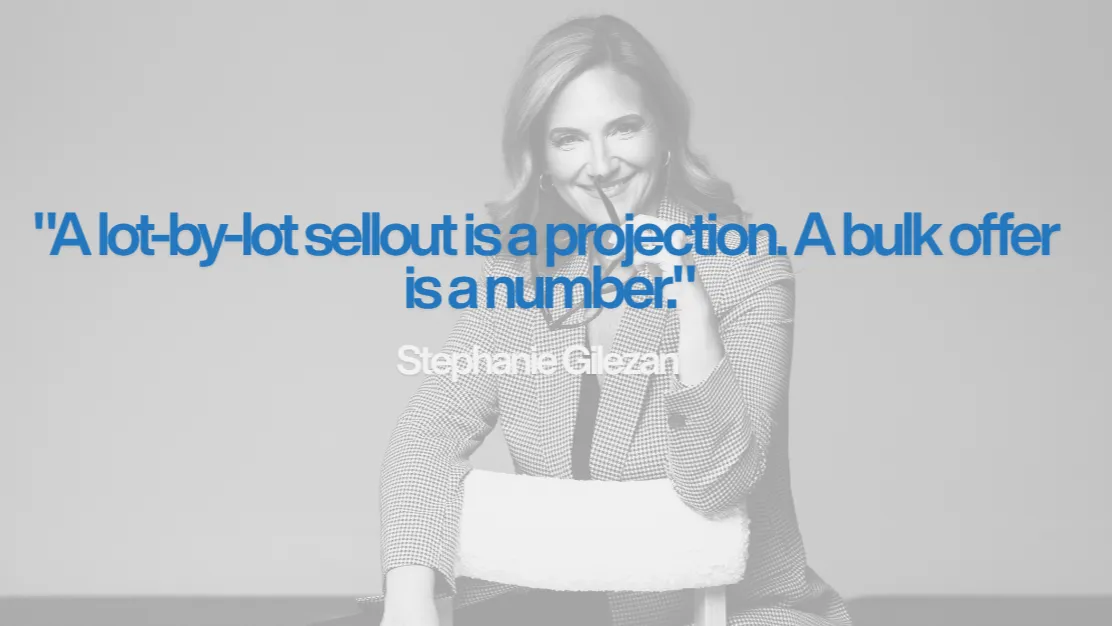
Lot-by-lot sellout gets you a projection. A bulk sale gets you a number. Destination developers should run both.
The most profitable way to sell a destination development is sometimes to stop selling it one lot at a time.
That runs against every instinct a developer has. The pro forma was built on retail absorption. Every lot, every villa, every homesite gets sold individually at full price, and the sum of those prices becomes the number everyone remembers. It is the number on the investor deck, the number the lender saw, and the number the developer tells friends at dinner.
It is also a gross number. And the market only pays net.
I am pricing a coastal destination project right now that sits squarely in this decision. The first phase is developed, the second phase is undeveloped, and the owner is weighing whether to keep selling individually or sell the whole thing to a single buyer. It is a common position. Many destination developers reach it after the first phase proves the concept, and before the second phase demands another round of capital, infrastructure, and years.
Here is the mechanic most owners underestimate. Retail sellout value is not what the developer keeps. From it you subtract marketing spend, sales commissions, carrying costs on unsold inventory, the dues subsidy the developer pays on lots it still owns, infrastructure for the next phase, and the time value of money across the full absorption period. In international and resort markets, add currency movement and the simple risk that buyer demand in year four doesn't look like it did in year one.
Run that honestly and the gap between a retail sellout and a well-priced bulk offer is often much narrower than the headline numbers suggest. Sometimes it disappears.
The real question in a bulk sale isn't "how big is the discount?" It is "whose balance sheet should carry the absorption risk?" A bulk buyer is a developer, fund, or operator who is paid to take that risk. They underwrite a discount because they are taking on the years, the marketing, and the uncertainty. If the current owner has better uses for capital, or simply does not want to spend another five years selling lots, transferring that risk at a fair price is not a concession. It is a strategy.
Structure matters. A developed phase and an undeveloped phase are different assets with different buyer pools. The developed phase has pricing evidence: closed sales, a finished amenity base, a product the market has already validated. The raw phase carries entitlement, infrastructure, and execution risk. Pricing them together as one blended number usually undervalues the first and overstates the second. Pricing each on its own terms, and then pricing the whole, gives the owner a clear view of where the value actually sits and which buyers will pay for it.
There are also tools between "sell everything" and "sell nothing." Seller financing can widen the buyer pool. A participation or earnout on future lot sales lets the seller keep some upside while shedding the operating burden. A phased takedown lets a buyer commit to the whole project while closing in tranches. Each has trade-offs, and each should be modeled against the retail plan rather than treated as a fallback.
My position is this: a lot-by-lot sellout is a projection, and a bulk offer is a number. Developers who treat the retail pro forma as sacred often leave real money on the table in carry and time, and they rarely account for what that capital and those years could have produced elsewhere. A discount is not a loss if it buys back half a decade.
None of this means every destination project should be sold in bulk. Some should absolutely be sold out individually, particularly where infrastructure is complete and demand is proven and deep. The point is that the decision should be made on net numbers, side by side, before momentum makes it for you.
If you are holding a destination or master-planned project and have only ever seen the retail number, let me run both. The comparison alone usually changes the conversation.
Developers and capital partners: at what point in a project have you seen bulk sale math beat retail sellout? Was it infrastructure cost, time, or buyer fatigue that tipped it?
Originally published on LinkedIn on October 2, 2026.
Related Markets: Development Land and Commercial Sites
- Real Estate Development
- Destination Property
- Luxury Real Estate
- Real Estate Investing
- Master Planned Communities
- International Real Estate
- Commercial Real Estate