
Global Investing · October 19, 2026
The 33% Premium Buys a License You Don't Control
Branded residences pass 1,000 developments this year, and the document that decides your resale is a management agreement the condominium is rarely a party to.
Savills prices the average branded residence at a 33% premium to comparable non-branded product, 30% in cities and 39% in resorts. Knight Frank counted 903 schemes worldwide at the end of 2025 and expects the sector to pass 1,000 developments this year, on a pipeline that reaches roughly 1,800 schemes and more than 300,000 units by 2031. Everyone quotes the premium. The number that decides what the unit is worth in 2034 is the license term.
The growth has also moved out of the city core, which changes what the premium is actually buying. Fewer than four in ten schemes sat outside major cities in 2016; more than half do today, and Knight Frank's pipeline work puts that at 57% by 2028. Phuket has more branded schemes in its pipeline than London. Dubai leads every city at 175 schemes, the Middle East holds 20% of global projects and somewhere between a quarter and a third of the pipeline depending on which cut of the survey you read, and the brands themselves are turning over: hotel operators run about 70% of what is already open and roughly 60% once the pipeline is counted, with fashion, automotive and design houses taking close to 40% of supply by 2028. A buyer in 2016 was mostly buying a Four Seasons attached to a Four Seasons hotel. A buyer closing in 2029 is as likely to be buying a logo attached to a resort tower on an island where three other brands opened the same year.
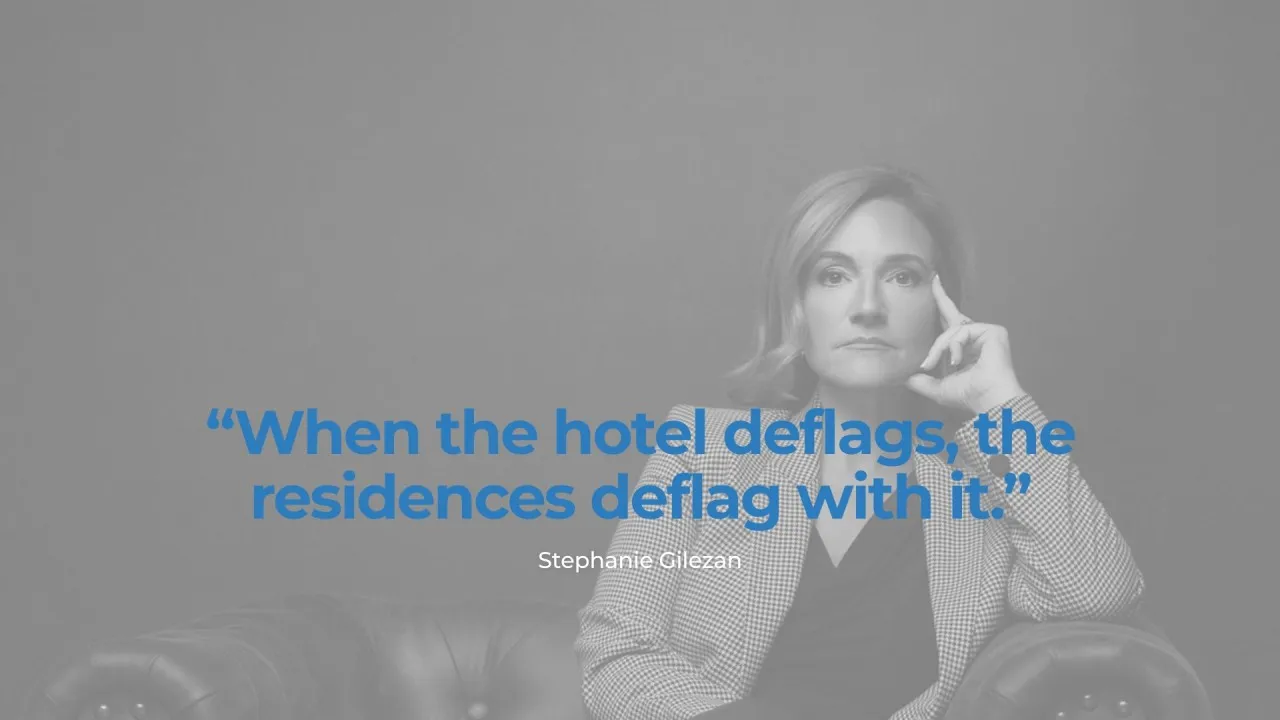
What transfers at closing is narrower than the marketing suggests. You take a deed to a unit and the benefit of a license agreement between the brand and the developer or hotel owner. The mark belongs to the operator, licensed for a term, with renewal options the operator controls, and termination rights that generally sit with the hotel owner or the developer entity. Todd Soloway at Pryor Cashman has argued for more than a decade that hotel owners hold an essentially unfettered right to terminate their managers, and that exercising it does not generally expose them to liability to the residence owners who bought on the strength of the flag. When the hotel deflags, the residences deflag with it. The sign comes down, the branded services agreement ends, and a unit that closed at a 33% premium becomes a well-built condominium with a story.
The carry works the same way and shows up a great deal faster. The brand fee, the marketing contribution, the FF&E reserve and the shared-facility charge usually arrive bundled inside one monthly number, and in a resort scheme that number can run several times the unbranded building down the road. A rental program mandate can dictate who markets your unit, at what nightly rate, and what share of it goes to the operator. A right of first refusal in favor of the developer sits on top of a resale and adds six weeks to a transaction that was already going to be slow. None of it appears in the price per square foot the buyer used to compare two towers.
My position will irritate the people who sell these for a living. The 33% premium is paid once, at entry, to the developer, and recovering it on exit depends on a contract the buyer never signed and cannot renew. So price the license the way you price a lease: term, renewal, who holds the option, and what the counterparty's incentive is to stay. Forty years remaining, an operating hotel generating management fees the operator wants to protect, and a funded reserve is one asset. Twenty years remaining, no hotel on the site, and an operator whose whole economic interest was the licensing check it collected during development is a very different asset at the same price per foot. Twenty-eight years and nearly 40 countries in, I have never watched a buyer get talked out of a premium by a brochure, and I have watched three get talked out of one by page 40 of the condominium documents.
The strongest case against me is the resale record, and it is a real one. Savills' premium holds into the secondary market, resort schemes measure at 39% over comparable product, and buyers who paid up for Mandarin Oriental or Four Seasons attached to a hotel that cannot be rebuilt on that block have done well. I would underwrite that again in Manhattan, Miami Beach or Madrid, where the land is finished and the operator loses more by leaving than by staying. That evidence comes out of a decade in which most schemes were urban and most brands were hoteliers. The supply now coming is resort, island and mountain, much of it standalone, into markets absorbing tens of thousands of competing branded units through 2031. A ten-year average premium tells you very little about a 2029 handover in Phuket.
The diligence that answers this is documentary and nearly free. Ask for the license or management agreement rather than the brochure, and read the term, the renewal mechanics and who holds termination. Ask what happens to the name on the building if the operator leaves, and whether owners get notice, a vote, or nothing at all. Ask for the brand fee as its own line item, and what that line was three years ago. Then put it in the paperwork: a representation in the PSA that the license is in full force with no notice of default or termination given, and a deposit that goes hard on receipt of the condominium documents and the brand agreement instead of on a calendar date. A developer sitting on a 40-year license sends all of it inside a week. A developer who starts explaining why the agreement is confidential has already answered the question.
I built Airdomo to put international property in front of buyers with the documents attached, because the distance between a rendering and a license agreement is where most of this money goes. If you are working a branded deal right now, bring it into the CRE Dealmakers Network and let the room read the license with you.
Originally published on LinkedIn on October 19, 2026.
- Branded Residences
- Luxury Real Estate
- Global Real Estate
- Cross Border Investment
- Second Homes
- Deal Structure
- Real Estate Investing