
Commercial Real Estate · June 23, 2026
The Deal-Maker Mentality: Why Most Agents Negotiate and Almost None Make Deals
Negotiation is defending a position. Deal-making is building a structure. The industry trains the first and almost never teaches the second.
I've watched thousands of transactions die. Very few of them died because the numbers didn't work. They died because the people in the room were negotiating when they should have been deal-making — and most of them couldn't tell you the difference.
Here's the difference.
Negotiation is positional. Two sides, one number, tug-of-war. Your job is to give up as little as possible and extract as much as you can. It's what the industry trains for, what the scripts teach, and what most agents think the job is. And it works fine — when both parties want the same simple thing and the only question is price.
Deal-making is structural. It starts from a different question entirely: not "what will they accept?" but "what does each side actually need, and how many ways can this transaction be built to deliver it?" Price is one variable among many — timing, terms, contingencies, financing, leasebacks, earnouts, escrows, who carries which risk for how long. A negotiator sees a $200,000 gap and starts grinding. A deal-maker sees a $200,000 gap and starts asking why it exists. Is the seller anchored to a number because of debt payoff? Tax exposure? Ego? A partner who needs a certain return? Each of those problems has a different structural solution, and almost none of them require the buyer to simply pay more.
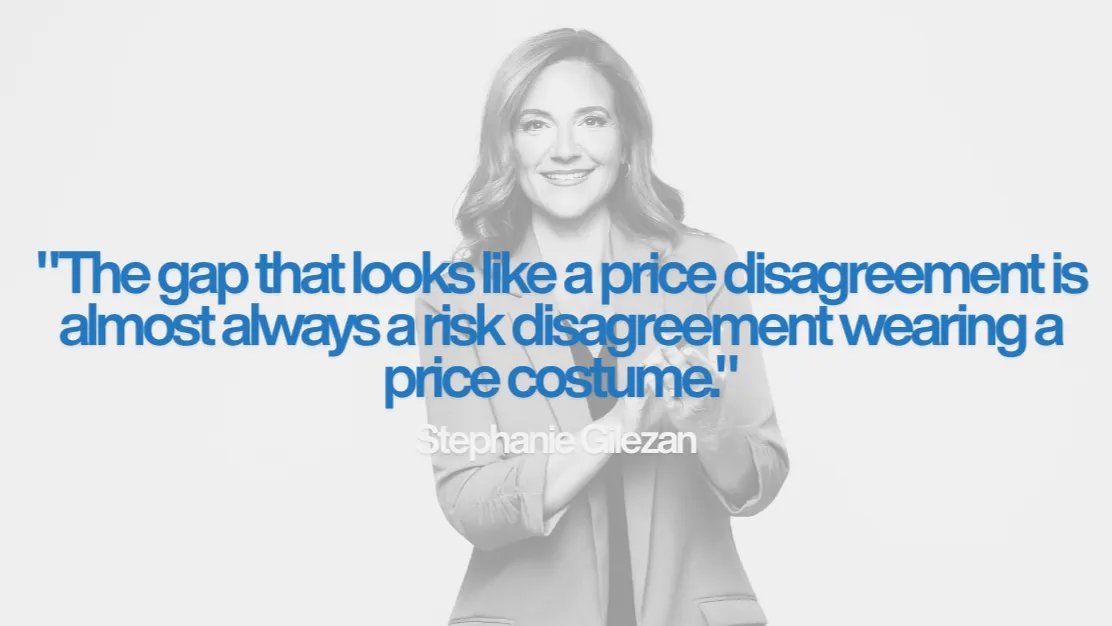
After 10,000+ transactions across residential, commercial, and business sales, I can tell you the pattern with confidence: deals don't usually die over value. They die over structure that nobody bothered to build. The gap that looks like a price disagreement is almost always a risk disagreement, a timing disagreement, or an information disagreement wearing a price costume.
A few principles from the deal-maker's side of the table:
Dead deals are usually dormant deals. When a transaction falls apart, most agents send a polite email and move on. I put it on a calendar. Circumstances change — debt matures, partners exit, health intervenes, markets move. A meaningful share of my career volume has come from re-approaching deals everyone else buried. The file isn't closed. It's resting.
The first structure offered is a draft, not a verdict. When someone rejects your offer, they've told you something specific if you're listening. "The price is too low" rarely means the price is too low. It means the package, as constructed, doesn't solve their problem. Change the construction before you change the number.
Know what the other side's "no" costs them. Every party who walks away from the table walks toward something another buyer, a refinance, a continued holding period, a courtroom. If you understand what their alternative actually costs them in money, time, and aggravation, you know exactly how much structure you need to build to beat it. Most agents never do this math. They just take "no" personally.
Creativity is not the same as complexity. Some of the best structures I've ever built fit on an index card. Seller carries a second for 18 months. Buyer leases back the warehouse so the seller's other business doesn't have to move. Price holds, but closing slides 90 days to solve a tax year problem. None of that is exotic. All of it is invisible to someone who only knows how to argue about price.
The reason this matters now and not just as career philosophy is that 2026 is a structure market. Rates are easing but they're not going back to 2021, capital is selective, and the gap between what sellers remember and what buyers will pay hasn't fully closed in every sector. In a market like this, the agents who can only negotiate price will keep watching deals die. The ones who can build structure will keep closing.
I built my "Deal-Maker Mentality" masterclass because after delivering a version of it to one network, the requests kept coming from agents, from team leaders, from business owners who realized they'd been bringing a negotiator's toolkit to a deal-maker's problem. It's the curriculum I wish someone had handed me 26 years ago, before I learned it the expensive way.
If your team is leaving deals on the table that better structure could have saved and statistically, it is reach out. The masterclass travels. The mentality stays.
Tell me about a deal you saved with structure instead of price or one you lost that better structure could have rescued. I read every reply.
Originally published on LinkedIn on June 23, 2026.
Related Markets: Franchise and Restaurant Businesses for Sale
- Deal Making
- Negotiation
- Real Estate
- Commercial Real Estate
- Business Brokerage
- Mindset
- Real Estate Agents
- Leadership